
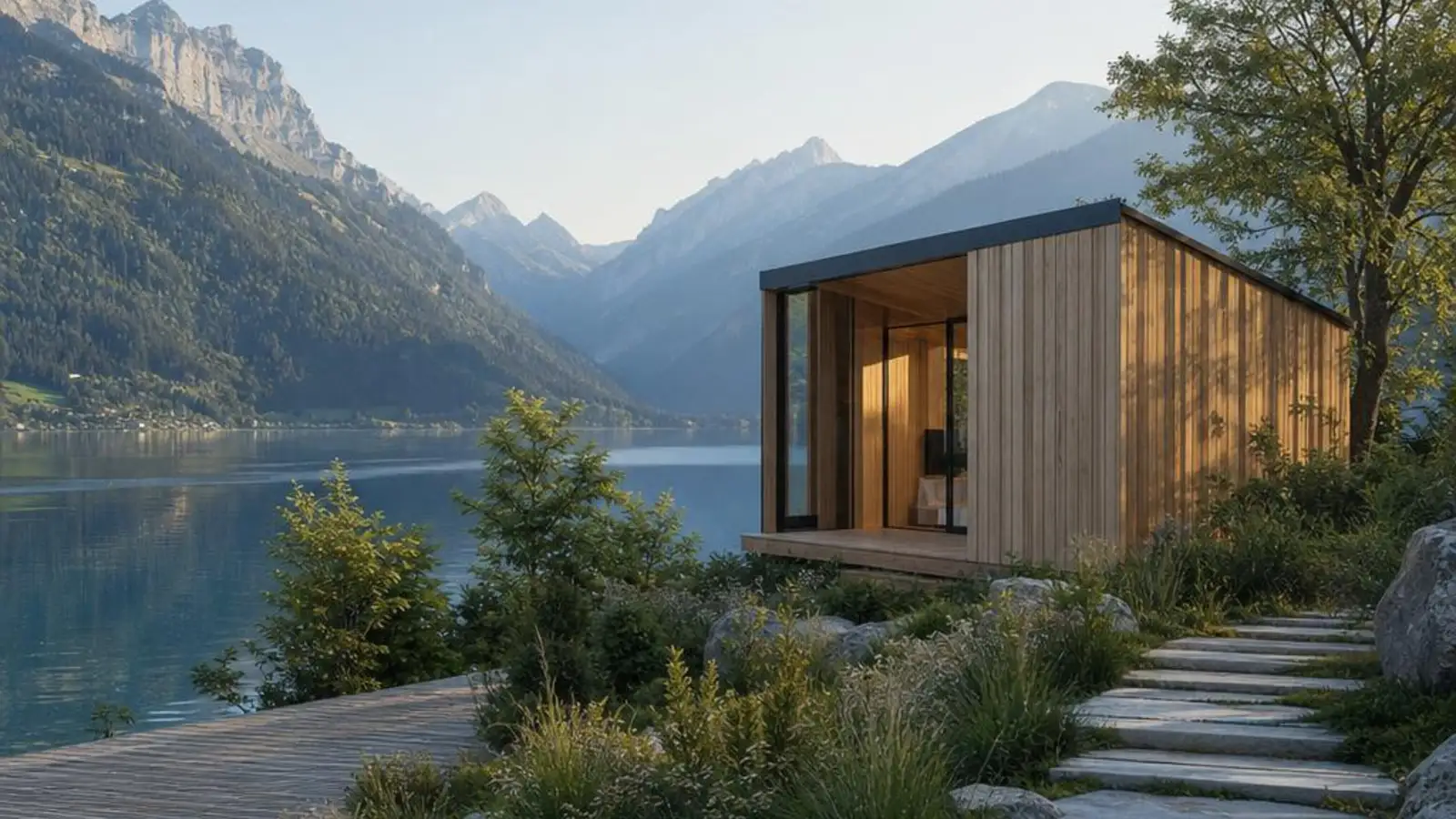
Planning a tiny house in Switzerland starts with the municipality and a specific parcel. National spatial-planning law establishes the core distinction between building zones and land outside them, while cantons and municipalities administer detailed rules and procedures. A trailer registration or foreign road certificate does not itself authorise long-term residential placement.
This guide does not invent a Swiss market price. No current primary catalogue with a verified scope and Swiss delivery commitment was established for the homes discussed, so the home, freight, crane, land and pitch figures remain “price on request”. The only example calculation below is expressly hypothetical and is not a market study.
Key takeaways
- Article 22 LAT sets the permit principle; Article 24 governs limited exceptions outside building zones.
- Ask the municipality about one parcel and one declared use before paying a non-refundable deposit.
- The Federal Office for Customs and Border Security publishes an 8.1% normal import VAT rate.
- Vaud, Geneva, Fribourg, Jura and Valais use distinct procedures and competent authorities.
- Budget in CHF with documentary evidence for the home, freight, site works, permits, utilities and tax.
Why should an expat check the parcel first?
Swiss planning decisions attach to land, proposed use and design rather than to the marketing label “tiny house”. Give the municipal building office the parcel number, intended main or secondary residence use, occupancy, installation duration, dimensions, foundation or chassis, water, wastewater, energy and access. An abstract question about whether tiny houses are legal cannot produce a dependable project answer.
The zoning plan and municipal building rules may regulate use, setbacks, height, appearance, parking and development status. Separate requirements may address fire safety, energy, natural hazards, water protection and road access. A seller’s floor plan can support the file but cannot establish that the parcel is buildable.
Foreign residents should request written answers and identify the working language of the authority. Buying property, holding a residence permit and obtaining construction approval are separate issues. This page makes no claim about an individual buyer’s eligibility to acquire real estate; that question requires case-specific official advice.
What do LAT Articles 22 and 24 mean?
Switzerland’s Federal Spatial Planning Act is commonly abbreviated LAT in French and RPG in German. Article 22 states the core authorisation rule for creating or altering buildings and installations. Its conditions include conformity with the zone purpose and sufficiently serviced land. A compact footprint does not create a blanket exemption.
Article 24 concerns exceptional approval outside building zones. Agricultural land, vineyards, forests and other non-building areas should not be treated as cheap residential alternatives. The fact that a unit can be lifted or towed does not create a general right to occupy such land.
The legal review has three levels: the federal act and ordinances, cantonal construction legislation and procedure, then municipal zoning and building rules. A permit assessment can also involve utilities, environmental protection, energy and safety. This is not legal, tax or investment advice.
| Level | Key question | Evidence |
|---|---|---|
| Federal | Building zone or Article 24 exception? | Official zoning and authority assessment |
| Cantonal | Which procedure and technical rules apply? | Cantonal guidance and filing list |
| Municipal | Is residential use and the design compliant? | Written response and local regulations |
| Project | Can access, services and performance be documented? | Dated drawings and specifications |
How do French-speaking cantons differ?
Vaud tells owners to approach the relevant municipality as soon as they intend to develop a project. The permit application is filed with the municipal administration. The municipality examines it, handles public notice and sends it through CAMAC for special cantonal approvals before granting or refusing the permit. Vaud’s official outside-building-zone guidance says most such projects require both cantonal authorisation and a municipal permit.
Geneva states that most construction, installation, extension, renovation or change-of-use works need authorisation under its LCI. Its published exemption for certain removable huts describes structures around 5 m² and 2 m high in a building zone, not residential tiny houses. Do not extrapolate that narrow exception to a habitable unit.
Fribourg requires ordinary, simplified and preliminary applications to be entered through FRIAC. Its official page cites Article 135 LATeC and explains that the prefect or municipal authority is competent depending on the nature and dimensions. Jura uses the JURAC online service; all small and large permit requests have had to be entered there since 1 July 2021.
Valais Construction Act Article 2 assigns projects inside building zones to the municipal council and projects outside those zones to the cantonal construction commission. The canton warns that outside-zone approvals face strict federal limits and must be issued or expressly approved in writing by the competent cantonal authority.
How should buyers compare Swiss regions?
A regional shortlist should compare legal feasibility before scenery or commute. For each candidate municipality, record the zoning designation, permitted residential use, secondary-home implications where relevant, services, hazard mapping, road geometry and the authority’s recommended procedure. Mountain access may affect transport engineering, but no generic Alpine surcharge is asserted without a route-specific quote.
German-speaking cantons apply the same federal Articles 22 and 24 but have their own building laws and local rules. The same is true in Ticino, where correspondence may be in Italian. A positive conversation in one municipality is not precedent for another parcel.
No claim is made here about an operating Swiss tiny-house settlement or a typical pitch rent because the required primary operational and price evidence was not established for this module. Treat project directories, social posts and property listings as leads for verification, not proof of planning status or availability.
What must be checked before importing the home?
The Federal Office for Customs and Border Security states that import tax is levied on all imported goods regardless of consignment value and that the normal rate is 8.1%. This verified number does not settle the customs treatment of every tiny house. The importer should confirm classification, taxable basis, declarations and whether a trailer and the building components require separate documentation.
The purchase contract should identify the importer of record and allocate export clearance, customs filing, freight insurance, border handling, route permits, crane work and final placement. It should list plans, weights, dimensions, electrical documentation, materials and energy data. A European manufacturer’s ability to deliver elsewhere is not proof of official Swiss delivery.
Road transport and permission to occupy land are separate. Oversize movements may require route planning and approvals, while a road-legal chassis addresses transport rather than residential siting. Check bridges, bends, gradients, overhead obstacles, delivery windows and crane reach with the actual carrier.
How does the 8.1% import VAT calculation work?
Use the official rate only after confirming the taxable basis. A purely hypothetical example makes the arithmetic visible: if the competent customs calculation accepted CHF 100,000 as the taxable basis, 8.1% would equal CHF 8,100. This is an assumption, not a quote, tariff promise, customs ruling or Swiss market observation.
The final basis may not be identical to a headline product price because the transaction and associated costs must be assessed under the applicable rules. Obtain a calculation from the customs authority or a qualified declarant using the real contract and Incoterms. Keep the result with the project budget.
Currency risk also belongs in the contract when the supplier invoices in euros or another currency. Record the agreed payment currency, conversion mechanism, instalment dates and responsibility for bank charges. This guide supplies no EUR-to-CHF forecast.
How can you build an evidence-based CHF budget?
Separate every cost rather than relying on a turnkey headline. The home and installed equipment need a dated specification. Freight needs a route-specific carrier quote. Crane and foundations depend on access and ground conditions. Utilities require local contractor offers. Permit fees and professional services depend on the authority and file.
Where primary evidence is missing, enter “price on request”, not an inherited range. A personal contingency can be added as an explicit planning assumption, but it should not be labelled a Swiss average. Update the sheet only when a new document changes a number.
Land purchase and pitch rent are location-specific and are not estimated here. If leasing a pitch, make the agreement identify the parcel, authorised use, term, utilities, access, insurance and consequences if approval is refused. Private permission from the owner never replaces public-law approval.
| Budget item | Current entry | Required proof |
|---|---|---|
| Home and equipment | Price on request | Dated supplier specification |
| Cross-border transport | Price on request | Route-specific carrier quote |
| Crane, support and utilities | Price on request | Site contractor quotes |
| Permits and consultants | To be confirmed | Authority fee data and proposals |
| Import VAT | 8.1% on confirmed basis | FOCBS or declarant calculation |
| Land or pitch | To be confirmed locally | Parcel-specific conditional contract |
Can a tiny house on wheels avoid a building permit?
Mobility is relevant but not decisive. Authorities can consider duration, residential use, physical servicing, supports, decks and effects on land. A unit that remains in one place and functions as a home should be presented candidly, including its chassis and intended movement pattern.
Road rules and planning rules answer different questions. Registration may permit movement on public roads; it does not grant residential land use. Conversely, a planning approval does not automatically confirm that a loaded combination can travel to the site.
Avoid contracts that promise “permit-free” Swiss residence without a parcel assessment and cited legal basis. Ask the municipality to classify the described arrangement in writing and state whether preliminary review, full permission or other approvals are needed.
What documents should an expat request?
Create a bilingual document list if the supplier and authority use different languages. Request dimensioned plans, elevations, sections, total and axle weights, structural description, insulation and energy data, electrical and plumbing diagrams, heating and ventilation details, fire-related materials, wastewater concept and installation method.
For the site, collect the cadastral plan, zoning extract, municipal rules, utility information, access survey, hazard information and owner consent. For import, retain the sales contract, invoice, origin and export documents, freight scope, insurance and customs instructions.
Translations should preserve measurements and technical terms and should be checked where the authority requires certified material. Do not assume an EU conformity document is sufficient for every Swiss building requirement. Ask the reviewing office which standards and signatures it expects.
- Send one precise project brief to the municipality.
- Obtain the filing route and required documents in writing.
- Make supplier commitments conditional where permit risk remains.
- Verify import responsibility and the taxable basis before shipment.
- Book transport and crane only against the approved site design.
What sequence reduces avoidable risk?
First, define the use and shortlist actual parcels. Second, ask each municipality for zoning and procedure guidance. Third, commission the drawings needed for preliminary feedback or a permit. Fourth, obtain a detailed home quote and site quotations. Fifth, confirm customs and transport responsibilities. Sign major unconditional commitments only when the remaining risks are understood.
Timelines are deliberately not promised. Municipal review, public notice, specialist approvals, objections, design revisions, manufacturing and transport can each affect the schedule. Ask every responsible party for a current written estimate and record dependencies rather than combining them into an unsupported national average.
A refusal or redesign request is possible even for a well-prepared proposal. A contract condition tied to the relevant permit may reduce commercial exposure, but its drafting needs professional review. This is not legal, tax or investment advice.
Frequently asked questions
Do I need a permit for a tiny house in Switzerland?
Can I place one on agricultural land?
How much does a tiny house cost in Switzerland?
What import VAT rate should I budget?
Does an EU road certificate replace Swiss planning approval?
Where do applications start in Romandie?
Citable summary
Permanent link · Editorial note„A residential tiny house in Switzerland requires a parcel-specific check under Federal Spatial Planning Act Article 22; Article 24 governs limited exceptions outside building zones. The Federal Office for Customs and Border Security publishes a normal import VAT rate of 8.1%. Official sources were accessed on 10 September 2026. No verified national home, land, pitch, transport or operating-project price is claimed in this research. Unverified amounts remain price on request, and the CHF 100,000 VAT example is explicitly hypothetical. This is not legal, tax or investment advice.“
Sources
- Fedlex — Federal Spatial Planning Act (official French text), Articles 22 and 24 – accessed 2026-09-10
- FOCBS — Import tax: taxable objects and tax rates – accessed 2026-09-10
- Canton of Vaud — Building permit procedure – accessed 2026-09-10
- Canton of Geneva — Request building authorisation – accessed 2026-09-10
- Canton of Fribourg — Building permits – accessed 2026-09-10
- Canton of Jura — Building permit section – accessed 2026-09-10
- Canton of Valais — Construction Act – accessed 2026-09-10